
Learn English from Scratch as an Adult: Where to Actually Start

You’re starting from zero. You can’t say much more than “hello” and “thank you”, and the idea of holding a conversation in English feels about as realistic as learning to fly. This is not a small ask — and anyone who tells you otherwise is selling something. Learning English — or any other language really — is no joke: doing it from scratch? Makes it even harder.
But here’s what’s also true: adults learn English from scratch every single year. Some of them are fluent within two to three years. Others spend a decade and plateau at a level that still embarrasses them in meetings. The difference isn’t talent. It’s method, mindset, and the willingness to be genuinely humble about what the process actually requires.
If you’re starting from zero, this guide is your honest briefing. Not a pep talk. Not a list of apps. A clear-eyed look at what works, what doesn’t, and what nobody tells you before you begin.
Before we get into the methods: if you’d like to find out whether a structured 1-to-1 approach is the right fit for where you’re starting, MEI’s free Chemistry Call is a 30-minute conversation with no commitment — just a chance to get clear on your goals and what a real learning plan looks like for you. Book your Chemistry Call and start with an edge.
What “Starting from Zero” Actually Means (and Doesn’t)
Absolute beginners are rarer than they think. Most adults who say they’re starting from zero actually have passive exposure that counts: they’ve absorbed English from films, music, apps on their phone, international signage. That’s not nothing. It won’t get you through a job interview, but it means your brain has already begun processing the phonetic landscape of the language.
That said, zero is zero when it comes to productive skills — speaking, writing, and structuring sentences. And that’s where the real work begins.
The question isn’t “am I a complete beginner?” The question is: “do I have a plan that takes me from wherever I actually am to wherever I need to be?” Most people don’t. And that’s the problem — not the starting point.
Why Your Mother Tongue Is Both Your Best Asset and Your Biggest Obstacle
This is the part most beginner guides skip entirely. And it’s probably the most important thing to understand before you start.
Every language carries a communicative logic — a set of implicit rules about how ideas are structured, how directness is calibrated, how emotion is expressed, and what counts as being polite, persuasive, or authoritative. You’ve been operating inside your native language’s logic your entire life. It feels like reality. It’s not — it’s one version of reality, encoded in one particular linguistic and cultural framework.
English has its own logic. And depending on where you’re starting from, that shift can be significant.
The Romance Language Starting Point
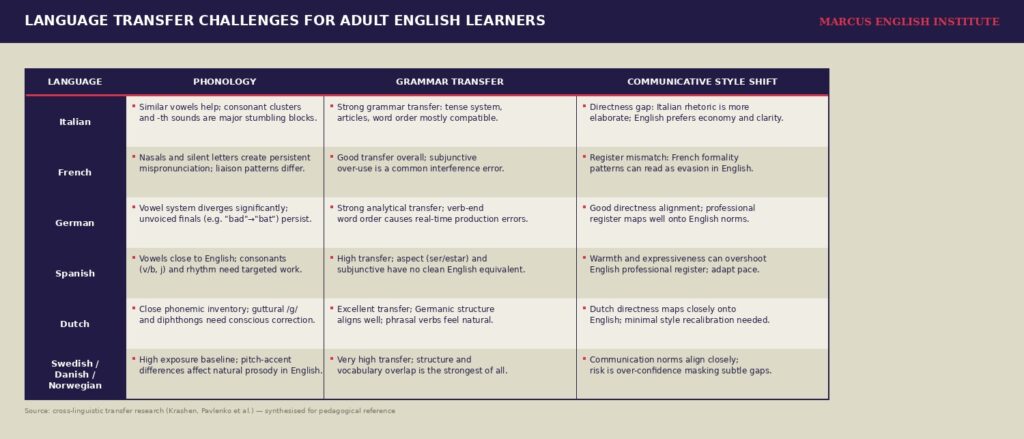
Speakers of Italian, French, Spanish, and Portuguese benefit from obvious lexical overlap — thousands of cognates, similar grammatical structures, a broadly compatible approach to sentence logic. The grammar feels familiar enough that some patterns transfer directly.
But this proximity comes with a hidden tax. Because the languages feel similar, Romance language speakers often underestimate how differently English handles rhythm, emphasis, and — crucially — directness. English business communication in particular tends to be more economical and more direct than its Italian or French equivalents. The elaborate framing that sounds authoritative in Italian can sound evasive in English. The politeness that works in French can read as indecision. These aren’t small details. They’re the difference between sounding fluent and sounding foreign even when your grammar is correct.
The Germanic and Nordic Starting Point
German and Dutch speakers often find English grammar less alien than Romance language speakers expect — there’s shared ancestry, similar clause structure, and Germanic directness maps onto English professional communication fairly naturally. Pronunciation, however, is a serious challenge; the vowel systems are divergent enough that German speakers frequently need dedicated phonetic work that Romance speakers don’t.
Scandinavian speakers often have the highest baseline — high English exposure from childhood, minimal phonetic distance, and cultural communication norms that align closely with Anglophone professional settings. That said, high comprehension in reading and listening doesn’t automatically translate into spoken fluency.
The Deeper Issue: Communicative Identity
Here’s what the research on cross-linguistic transfer actually shows — and this is worth sitting with: the difficulty of learning a new language isn’t purely phonological or grammatical. It’s cognitive and psychological. Psycholinguists including Krashen, Vygotsky, and more recently Pavlenko have documented how deeply intertwined language and identity are. When adults switch languages, they don’t just switch codes — they engage a different self-concept. The voice that feels confident and witty in Italian may feel flat and childlike in English. That’s a real experience. It’s also temporary.
The point isn’t that some nationalities have an easier time — though some genuinely do, at least in the early stages. The point is that every learner arrives with a communicative identity shaped by their mother tongue, and that identity will both help and hinder them in specific, predictable ways. A good teacher knows this. A good learner does too.
The Humility Problem — and Why Most Adults Get This Wrong
There’s a mistake almost every adult language learner makes. It’s understandable. It’s also almost guaranteed to slow you down or stop you entirely.
The mistake is this: trying to be, in English, exactly who you are in your native language.
You want to express the same ideas, with the same nuance, the same wit, the same emotional register. You want to make the same kinds of jokes, argue with the same precision, tell stories with the same rhythm. And when you can’t — because the words aren’t there, because the structures don’t map, because what sounds elegant in your language sounds awkward in English — it feels like failure.
It’s not failure. It’s what learning actually feels like.
Learning a new language as an adult is, in a real sense, learning a new version of yourself. The same person — same values, same intelligence, same sense of humour — but expressed through a completely different communicative system with its own rhetoric, its own cultural logic, its own way of building meaning.
The adults who make rapid progress are the ones who accept this early. They allow themselves to be simpler in English than they are in their native language. They say less, and say it more clearly. They resist the urge to translate their personality directly, and instead let a new communicative identity emerge gradually, through practice and exposure.
The adults who stall are usually the ones who can’t tolerate this gap — who feel so frustrated by the distance between who they are and who they sound like in English that they avoid speaking at all. That avoidance is the real enemy.
Linguist Aneta Pavlenko, whose research on bilingualism and identity has informed second language acquisition theory for decades, describes this as the construction of a “second language self” — a process that requires not just linguistic work, but psychological flexibility. That’s not dramatic. It’s accurate.
The Method Problem — Why Most People Start Wrong and Stay Wrong
Here’s the maths nobody does.
A well-structured learning plan — one hour of optimised, targeted practice per week — might take you three years to reach conversational fluency. That’s already a long road. Now consider what happens when every hour of structured work is replaced with four hours of disorganised, low-quality practice. You’re not learning three times slower. You’re potentially not progressing at all, because you’re reinforcing bad habits faster than you’re building good ones.
This isn’t an exaggeration. It’s what most self-directed adult learners actually experience. They spend years “studying” English — using apps, watching shows, picking up phrasebooks — and measure their progress in the vague currency of feeling slightly more comfortable. But feeling comfortable and becoming more capable are not the same thing.
Order and methodology matter disproportionately at the beginning. At an advanced level, a little disorganisation is tolerable — you have enough structure in your language to absorb input relatively efficiently. At zero, every hour either builds a solid foundation or lays down a crack that will widen as you go.
What does a well-structured beginning look like?
1. Start With Sound, Not Words
Before you learn vocabulary, spend time with the phoneme system of English. English has approximately 44 phonemes — distinct sounds — many of which don’t exist in most European languages. If you don’t develop an ear for them early, you’ll spend years mishearing and mispronouncing things in ways that are difficult to correct later.
Concretely: listen to clear, well-articulated English speech — audiobooks, news broadcasts, language learning audio — before you try to speak. Give your brain time to absorb the sound patterns. Then start producing.
2. Master the Core Structures First
English has a small number of high-frequency grammatical structures that carry the vast majority of everyday communication. Present simple, present continuous, past simple, going to future, modal verbs. Get these right — really right, so they come automatically — before moving on to anything more complex.
Most beginners skip ahead too fast, ending up with a patchwork of half-learned structures that collapse under pressure. Speaking is a real-time performance. There’s no time to think. The only things that come out under pressure are things that have been practised to the point of automaticity.
3. Build a Vocabulary Core, Not a Vocabulary List
The 1,000 most common words in English cover approximately 85% of everyday conversation. The 2,000 most common words cover around 92%. This means that learning 2,000 words well is more useful than learning 5,000 words poorly. Focus on high-frequency vocabulary, learned in context — not lists.
What “in context” means in practice: you encounter a word in a sentence, understand its meaning from that sentence, and then use it in your own sentence within 24 hours. That’s how vocabulary moves from recognition to production.
4. Speak From Day One — But With Structure
There is a school of thought that says beginners should listen for months before attempting to speak. For most adults with specific goals and limited time, this is impractical advice.
What’s true is that unstructured speaking too early — before you have any sound patterns, grammar, or vocabulary — can cement bad habits. What’s also true is that structured speaking practice, even at a very early stage, accelerates acquisition dramatically. A qualified teacher can design speaking tasks that are appropriate for a complete beginner: controlled, supported, corrected in real time. That’s not the same as being thrown into a conversation and expected to improvise.

The Best Methods to Learn English from Scratch as an Adult
With the foundations clear, here’s an honest breakdown of what works and what doesn’t.
1-to-1 Lessons with a Qualified Teacher
If you’re starting from zero, this is where a skilled teacher makes the largest difference. The reason isn’t obvious until you think it through: a beginner has no internal reference system yet. You don’t know what correct English sounds like well enough to self-correct. You don’t have the grammatical framework to identify your own errors. You need an external expert to diagnose precisely what you need, in precisely the right sequence, at precisely the right pace.
The key word, again, is qualified. CELTA-certified teachers with experience in adult beginners are trained in exactly this — in the kind of pedagogical scaffolding that takes someone from nothing to something in a structured, logical way. A native speaker who “just teaches” is not the same thing.
At MEI, all tutors hold the Cambridge CELTA with a minimum of ten years’ adult teaching experience. For a beginner, the structure that comes with that experience isn’t a luxury — it’s the difference between building a solid foundation and spending years wondering why you’re not improving.
Comprehensible Input — At the Right Level
Linguist Stephen Krashen’s input hypothesis — the idea that language is acquired when we understand messages slightly above our current level — has held up well over decades of research. For a complete beginner, this means exposure to English that you can mostly understand with effort, not English that’s entirely beyond you.
In practice: graded readers, podcasts designed for learners (not native speaker podcasts), simple YouTube channels in English, basic TV shows with English subtitles. The aim is to give your brain consistent, patterned exposure to the language at a level where it can extract structure from context.
Spaced Repetition for Vocabulary
Apps like Anki use spaced repetition algorithms to schedule vocabulary review at the optimal moment before you forget. This is one of the few ways apps genuinely help beginner learners. Used well — with contextual sentences, not isolated words — spaced repetition can significantly accelerate vocabulary acquisition. Used as a substitute for real learning, it produces recognition without production. Supplementary tool, not a learning plan.
Shadowing for Pronunciation
Shadowing — listening to a native speaker and simultaneously repeating what they say, mimicking rhythm, stress, and intonation — is one of the most effective techniques for developing natural-sounding English at the beginner-to-intermediate stage. It feels strange at first. It produces noticeable results within weeks of consistent practice. Ten minutes a day is enough to see change.
A Word on Apps
Duolingo, Babbel, and similar apps have their place in a beginner’s toolkit — specifically as habit-forming warm-ups and basic vocabulary builders. They are not, on their own, a route to fluency. They can’t give you corrective feedback on spoken production, adapt to your specific learning profile, or prepare you for the real-time cognitive demands of actual conversation. If apps are your main study tool, you’re optimising for streaks rather than progress.
How Long Does It Take to Learn English from Scratch as an Adult?
The honest answer: longer than most people want, and less long than most people fear.
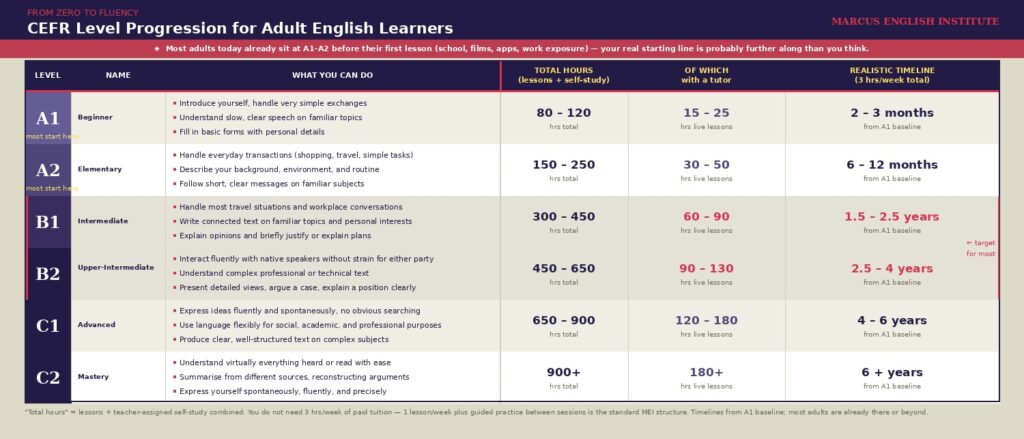
The Common European Framework of Reference (CEFR) provides the most widely used benchmark. For a complete beginner:
- A1 to A2 (basic survival English): roughly 150–200 hours of structured study
- A2 to B1 (lower intermediate, functional in most everyday situations): roughly 200–250 additional hours
- B1 to B2 (independent user, able to handle most professional situations): roughly 150–250 additional hours
That totals somewhere between 500 and 700 hours of structured work to reach a genuinely useful professional level. At two to three hours of structured practice per week, you’re looking at three to five years. At five to six hours per week (ambitious, but achievable for motivated adults), you could reach B2 in two to three years.
These numbers assume structured, high-quality learning time — not passive listening, not app streaks, not occasional conversation with a friend who’s also a non-native speaker. Real learning hours, used well. You can find out more about learning English fast, but honestly we wouldn’t suggest rushing when starting off, consistency is your priority here.
The variables that affect this most: how close your native language is to English, how consistent your practice is, and the quality of feedback you receive. The last one is the most underestimated.
Building Your Beginner Study Routine: A Practical Framework
A good beginner routine has three components: live input with an expert, independent practice with a plan, and passive exposure.
A workable weekly plan for an adult starting from scratch might look like this:
- 1 × 50-minute 1-to-1 lesson with a qualified teacher (structure, correction, progression)
- 2 × 15-minute shadowing sessions using material assigned by your teacher
- Daily 15–20 minutes of graded listening or reading at A1–A2 level
- 10 minutes of spaced repetition vocabulary review (Anki)
- One short writing exercise per week (even three sentences) reviewed by your teacher
That’s roughly three hours per week. The key word in all of this is “assigned” and “reviewed” — the independent work should be designed by your teacher, not improvised by you. At the beginner stage, improvised self-study is very easy to get wrong in ways you won’t notice until months later. Think of the 1-to-1 session as the engine: it directs everything else and corrects course every week.
What the MEI Approach Looks Like for a Complete Beginner
MEI works exclusively with adults. Every programme is built one-to-one, from a proper diagnostic of where you actually are — not a self-assessed level, not a category, but a specific picture of your current abilities and gaps. For a complete beginner, this means starting with the genuine basics: phonological awareness, core grammatical structures, and the most immediately useful vocabulary for your context.
All MEI tutors hold the Cambridge CELTA qualification with a minimum of ten years of adult teaching experience. That combination matters for beginners specifically, because CELTA-trained teachers are skilled at sequencing — at knowing what needs to come before what, and at preventing the kind of foundational errors that take years to unlearn.
Sessions are one-to-one, conducted online, and structured around your schedule with the flexibility to move things when life intervenes. You get a tutor who knows your profile, tracks your progression week by week, and adjusts the plan based on what’s actually working.
The free Chemistry Call is worth doing even if you’re still at zero. Thirty minutes to understand exactly what a structured learning plan looks like for your situation, your goals, and your starting point. No commitment. Just clarity.
FAQ — Frequently Asked Questions About Learning English from Scratch
Can I really learn English from zero as an adult?
Yes — and the evidence is not ambiguous on this. Adults learn languages differently from children, but not worse. You have stronger analytical reasoning, clearer motivation, and a broader knowledge base to map new language onto. The critical period hypothesis — the idea that adult language acquisition is fundamentally limited — has been significantly overstated in popular culture. What limits adult learners isn’t biology. It’s usually method, consistency, or the absence of expert guidance.
How can I learn English from scratch on my own?
Self-study is possible, but high-quality self-study as a complete beginner is genuinely difficult. Without a reference system for what correct English sounds like, it’s very easy to practise errors rather than correct them. That said: if self-study is your only option, prioritise graded listening (not native-speed content), a structured vocabulary programme using spaced repetition, and regular written output that you find ways to get corrected — language exchange platforms, online tutoring, or even AI tools with corrective feedback built in.
The risk to be honest about: self-study at the beginner level has a very high dropout rate, precisely because progress is hard to measure and the absence of expert correction means you often can’t tell whether you’re improving or just getting more comfortable with your errors.
What is the best app to learn English from zero?
Apps are useful as habit-forming supplements — not learning plans. For a complete beginner, Duolingo or Babbel can help with basic vocabulary and routine exposure. Anki is more useful for vocabulary acquisition specifically. None of them will produce spoken fluency. They don’t give you corrective feedback on spoken production, and they can’t adapt to your specific gaps. Use them as warm-ups to a real learning plan, not as a substitute for one.
How long does it take to learn English from scratch?
A realistic target for a complete beginner to reach B2 (upper-intermediate — genuinely functional in most professional settings) is three to five years at two to three hours of structured practice per week. More hours per week, or access to higher-quality guidance, can accelerate this. Native language proximity to English also plays a role: Romance language speakers typically find the early stages easier than speakers of more structurally distant languages.
Do I need a teacher to learn English from zero, or can I manage alone?
Technically, no. Practically, a teacher makes a substantial difference — especially at the beginning. A qualified teacher provides three things self-study can’t: sequenced instruction (knowing what to teach and when), corrective feedback on spoken production, and accountability. The last one is underestimated. Consistent practice over years is hard. Having a structured schedule with an expert who tracks your progress week to week is a significant part of why some adults reach fluency and others don’t.
Should I focus on grammar or speaking first when learning English from scratch?
Neither grammar nor speaking in isolation — both, from the start, in calibrated proportion. You need enough grammar to produce structured sentences; you need to speak from early on or you’ll never develop automaticity. What to avoid is the common trap of spending months on grammar study before attempting to speak. Grammar knowledge and spoken production are different skills. One does not automatically produce the other.
Ready to Start the Right Way? ☺️
Starting from zero is the hardest part. But it’s also the moment when the decisions you make about method and structure matter most — because what you build now is the foundation everything else sits on.
If you want to be clear about what a structured plan actually looks like for your situation before you commit to anything, MEI’s Chemistry Call is exactly that. Thirty minutes, no sales pitch, just a clear picture of where you are and what a realistic route forward looks like.