
How to Learn English Fast as an Adult: 7 Methods That Actually Work

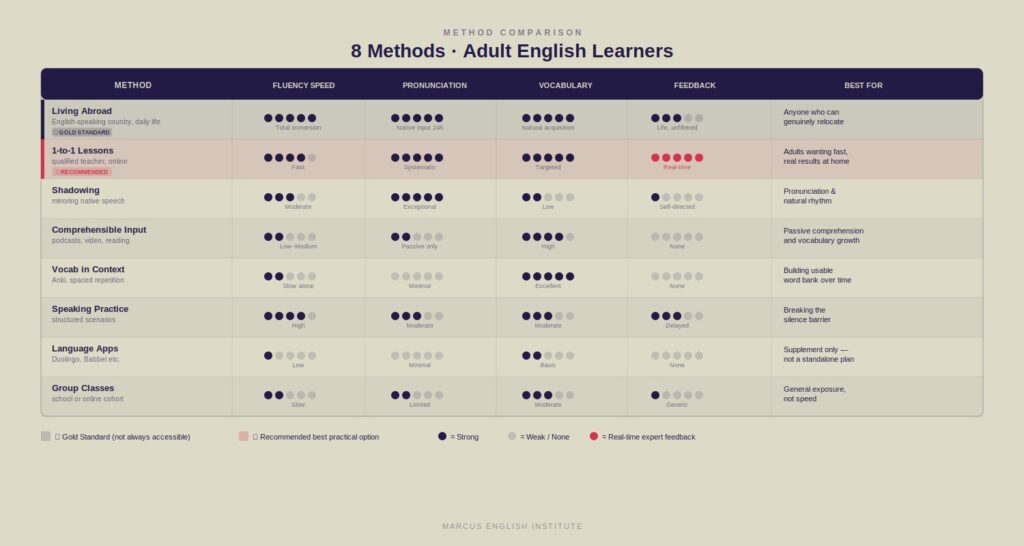
Let’s not waste each other’s time with a diplomatic preamble. The most effective way to learn English fast as an adult is to go and live in an English-speaking country. Full immersion, no safety net, every transaction of daily life conducted in English — buying groceries, navigating bureaucracy, arguing with a flatmate. If that’s a genuine option for you, close this tab and go pack. Nothing in this article will outperform it.
But there’s a version of this story that needs complicating before we move on, because a lot of adults have ‘done the abroad thing’ and come back wondering why their English didn’t move as much as expected.
The language-learning-abroad industry has a structural tension at its centre. It needs to sell an enjoyable experience to a diverse international cohort. Which means: programmes that aren’t genuinely intensive, because real intensity would drive down reviews and bookings. Cohorts where you consistently end up spending your social time with people who share your native language — Italians with Spaniards, French with Italians, Ukrainians with Russians, each understanding the other perfectly in their own tongue while technically ‘abroad’. And an industry preference for flagship destinations like London and New York that, for all their appeal, are so cosmopolitan and distracting that English often becomes just one of many languages in the room. The smaller, less glamorous towns that would actually accelerate your learning don’t sell enough brochures.
So: full daily life in an English-speaking country, genuinely lived, is extraordinary. Structured language programmes abroad are considerably more complicated than the marketing suggests.
Everything below assumes you’re staying put. Here’s what actually works.

The Honest Answer: What ‘Fast’ Actually Requires
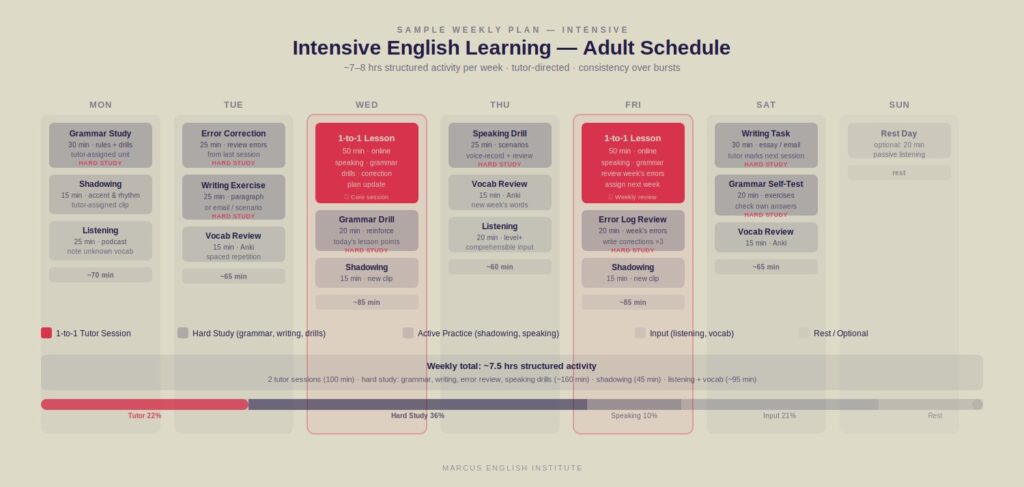
So if you genuinely want to learn English fast as an adult without relocating, here’s what the evidence actually points to. The second most effective method after full immersion is an intensive programme with a qualified, dedicated tutor — ideally two to three sessions of 45–50 minutes per week — combined with four to six hours of structured independent practice, updated weekly by your tutor.
That’s a significant commitment. We know. But consider what we’re actually describing: compressing years of language acquisition into months. Fluency in a second language is not a weekend project. If you want results that meaningfully change what you can do in English — professionally, socially, in real situations that matter — this is the level of input that makes accelerated progress possible. Everything below this threshold will still improve your English. Just more slowly.
If you’re looking for a structured programme that fits around a professional schedule, MEI’s 1-to-1 online lessons for adults are built around exactly this approach. But more on that later.
A Note on Finding the Right Tutor
Before the methods, a word on the tutor question — because it causes a lot of unnecessary confusion.
The tutor doesn’t need to work for MEI, or any particular school. What they do need to be is a properly qualified professional: solid pedagogical training (CELTA or equivalent is a reliable benchmark) and real experience specifically teaching adults. Adult language acquisition has its own mechanics — it’s different from teaching children, different from general language coaching, and entirely different from simply being fluent in English yourself.
On the native speaker question: some of the finest English teachers in the world — and anyone who has attended or observed Cambridge CELTA and DELTA training programmes will confirm this — are not native speakers. Teaching a language professionally requires mastery of concepts like interlanguage development, communicative competence, task-based instruction, error analysis, contrastive phonology, and scaffolding techniques — none of which come automatically with a native passport. A fluent speaker without teaching training is not equipped to teach effectively. A non-native with CELTA, Delta, and a decade of adult classroom experience unquestionably is.
To be transparent about where we stand: MEI tutors are native or near-native speakers, which some learners find helpful for pronunciation modelling, and which is part of our approach. But it’s worth being honest that non-native teachers with the right qualifications and experience can be equally effective. The credential and the experience are the actual filters, wherever the teacher is from. Read more in our article on native vs non-native English teachers.
7 Methods to Learn English Fast as an Adult
1. Intensive 1-to-1 Lessons — The Core That Can’t Be Skipped
The single most effective thing you can do to learn English fast as an adult — short of moving countries — is to work regularly with a qualified teacher in a 1-to-1 format. Group classes and apps can move the needle. Neither is a substitute for regular, personalised sessions with a qualified teacher when speed is the goal.
The reason is feedback density. In a group class, you might produce spoken English for five minutes across a full hour. In a 1-to-1 session, you’re speaking, being corrected in real time, and adjusting for the entire duration. That ratio is the difference between slow progress and fast progress.
Two to three sessions per week is the minimum for meaningfully accelerated learning. One session per week is better than nothing — it’s just not fast.
2. Structured Independent Practice — Assigned, Not Random
The hours between lessons matter as much as the lessons themselves. But ‘doing something in English’ is not the same as structured practice. Watching a series, reading an article, scrolling English-language content — these build passive comprehension at best.
What actually accelerates progress: tutor-assigned exercises targeting your specific weak points. Pronunciation drills for the sounds you actually mispronounce. Vocabulary work in the register you actually use. Speaking scenarios built around the situations you’ll actually face. The tutor designs the practice, tracks your progress, and updates the plan. You do the hours independently — but with a clear purpose, not guesswork.
3. Shadowing — Probably the Most Underused Technique in Existence
Shadowing works like this: take a short audio clip of natural spoken English — ideally matching the accent and register you’re working towards. Press play. Simultaneously repeat what you hear, mirroring the rhythm, the intonation, the pace, the connected speech. Don’t pause. Don’t translate. Just mirror.
It’s uncomfortable for the first few sessions. It’s also one of the most effective tools for building the physical muscle memory of spoken English — the mouth positions, the reduced vowels, the natural flow that textbooks can’t teach. Ten focused minutes a day produces noticeable results within weeks.
4. Comprehensible Input at the Right Level (Krashen Was Right)
Stephen Krashen’s input hypothesis holds up: we acquire language most efficiently when we understand the message but have to work slightly for some of it. Roughly 80–85% comprehension is the productive zone — you follow the meaning, but there are gaps that stretch you. Too easy and nothing new enters. Too hard and nothing lands.
This means: don’t only consume content you already understand perfectly, and don’t only attempt content you can barely follow. Find the middle. A podcast where you catch most of it. A film without subtitles where you’re genuinely working. Your tutor can identify the right level for where you are.
5. Vocabulary in Context — Not Lists
Memorising vocabulary lists is one of the least efficient uses of study time. Words learned in isolation rarely surface in spontaneous speech because you’ve stored the word without its surrounding environment — the collocations, the register, the grammatical patterns it lives in.
Learn vocabulary through reading and listening, then use new words actively within 24 hours of encountering them. A written sentence, a spoken drill, a voice note to yourself in English. Spaced repetition tools like Anki help consolidate over time — but the initial encounter needs to be in context, not on a flashcard.
6. Speaking Before You Feel Ready
There is no moment at which you will suddenly feel ready to speak. The readiness comes from speaking imperfectly, repeatedly, in a safe environment, until the imperfections reduce. Waiting to feel confident before practising is how you build excellent passive comprehension and complete paralysis when a real conversation starts.
A good tutor’s job is partly to push you into speaking before you’re comfortable. The discomfort is the mechanism. The safe environment is what makes it productive rather than just stressful.
7. Accent Coaching — Know When to Bring in a Specialist
If accent reduction or accent acquisition is your primary goal — getting closer to a specific variety of English for professional or personal reasons — it’s worth knowing that dedicated accent coaching is a specialist niche. Accent coaches, often with backgrounds in voice work, phonetics, or drama training, go deeper into individual sounds and prosody than most general English teachers.
The honest caveat: specialist accent coaches are expensive, and most adult learners don’t need that level of focus. For the majority, the pronunciation improvement that comes from regular 1-to-1 lessons with systematic phonetic feedback is more than sufficient. But if accent is the primary objective, the specialist exists — and knowing that is useful.
How Long Does Learning English Fast Actually Take?
Any specific timeline without knowing your starting level is a guess. Here’s what the CEFR research actually suggests:
- A1 to B1 (basic to intermediate): roughly 250–400 hours of structured learning
- B1 to B2 (intermediate to upper-intermediate): roughly 150–250 additional hours
- B2 to C1 (upper-intermediate to advanced): roughly 200–300 additional hours
How quickly you can learn English fast as an adult depends almost entirely on the quality and consistency of your method — not on age, aptitude, or how many apps you’ve downloaded. Those hours cover both guided study and structured independent practice. With a genuinely intensive programme — the two to three sessions per week plus four to six hours of independent work described above — a learner moving from B1 to B2 can expect tangible, noticeable improvement within four to six months. Sometimes less.
The consistent truth: sustained effort over time outperforms occasional intensity every time. A programme you can maintain for six months beats a sprint you abandon after four weeks.
What Slows Adults Down (Even When They’re Trying Hard)
Studying without speaking. Apps, grammar exercises, vocabulary lists — useful supplements, not substitutes. Spoken fluency only develops through speaking, with feedback.
Passive input masquerading as study. Watching Netflix in English is not a study plan. It’s procrastination with subtitles. Comprehensible input matters, but it builds passive comprehension. Speaking is an active skill. The only way to develop it is to produce it, under pressure, with correction.
No corrective feedback. Colleagues nod politely. Native speaker friends let errors slide. Language exchange partners are learners themselves. Without consistent expert correction, fossilised errors — mistakes so ingrained they feel natural — become permanent. They rarely self-correct through exposure alone.
Generic study instead of targeted study. A professional preparing for client presentations in English needs different work from someone preparing for a Cambridge exam or learning to travel confidently. Generic coursebooks don’t make these distinctions. Targeted study, built around your actual situations, is significantly faster.
FAQ — Learning English Fast as an Adult
What is the fastest way to learn English as an adult?
The fastest way to learn English fast as an adult — and the one that consistently produces real results — is regular 1-to-1 sessions with a qualified teacher, combined with structured independent practice between lessons, is consistently the fastest route. It concentrates personalised feedback, targeted output, and consistent accountability in a format that fits an adult’s schedule. The minimum for genuine acceleration is two to three sessions per week plus several hours of assigned practice.
Can I learn English fast without moving abroad?
Yes. Living genuinely abroad in an English-speaking country is the gold standard — but structured programmes abroad often underdeliver for the reasons described above. An intensive programme with a qualified teacher at home, done properly, is the most effective alternative and produces real results for most adult learners.
How many hours per week do I need to learn English quickly?
If fast progress is the actual goal: two to three tutor-led sessions per week plus four to six hours of structured independent practice is a realistic minimum. Anything below that will improve your English — just not quickly. Consistency over time matters more than occasional intensity.
Is it possible to learn English fluently in 3 months?
It depends entirely on starting level. A motivated learner at B1 following an intensive programme can make very noticeable progress in three months — real, practical improvement. Professional-level fluency from zero in three months is not realistic. Anyone claiming otherwise is selling something.
Do apps like Duolingo actually help you learn English fast?
Apps support vocabulary retention and basic comprehension maintenance. They don’t produce spoken fluency and can’t replace personalised feedback or real speaking practice. Think of them as a supplement — useful additions to a proper learning plan, not a replacement for one.
How important is pronunciation when learning English quickly?
Very — and it’s often neglected because improving it requires active correction, not just exposure. Pronunciation habits that cement themselves early are difficult to undo later. Regular feedback from a qualified teacher, combined with shadowing practice, is the most effective approach for most adult learners.
Ready to Actually Accelerate Your English? ☺️
If you’ve read to here, you already know that learning English fast isn’t a mystery. It’s a commitment to the right things, done consistently, with proper guidance.
MEI works with adults who are serious about results: professionals, academics, travellers, seniors who want to engage with the world in English. All tutors hold the Cambridge CELTA qualification with a minimum of ten years of adult teaching experience. Lessons are 1-to-1, online, and built around your goals — not a standardised curriculum.
The first step is a free Chemistry Call — a short, no-commitment conversation where we find out what you need and whether we’re a good fit. No sales pitch. Just a proper conversation.


