
How to Practise Speaking English When You Have Almost No Time

You open the app. You do five minutes. The little flame stays alive. You close the app and go about your day feeling vaguely virtuous about the whole thing.
Spoiler: nothing just happened to your English.
The idea that you can build spoken fluency through micro-doses of gamified vocabulary — a quick Duolingo streak here, a passive podcast commute there — is one of the most persistent myths in language learning. It’s also, unfortunately, a very comfortable one. Apps are designed to make you feel productive. That’s not the same as making you better at speaking.
This article is for adults who are genuinely short on time and genuinely want to improve their spoken English. Not the next app to try. Not a motivational pep talk. Practical methods, ranked by effectiveness, with honest caveats about each. If you want to get a clearer sense of your current level before diving in, MEI’s free online English test takes about ten minutes.
Why ‘A Little Every Day’ Isn’t Enough (If It’s the Wrong Kind of Practice)
Consistency matters. But consistency doing the wrong thing just makes you consistently bad at it.
The speaking problem for most adult learners isn’t volume — it’s type. They accumulate hours of passive exposure (listening, reading, watching) and almost no active output. Speaking is a productive skill. The only way to improve it is to produce it, with feedback, repeatedly. Ten focused minutes of structured speaking practice will do more for your fluency than an hour of Netflix in English. Not because the Netflix hour is useless, but because it isn’t practice.
The research on this is fairly unambiguous. Comprehensible input matters — Krashen’s input hypothesis has held up well over the decades — but input alone doesn’t produce output. Output, including speaking, requires its own deliberate practice. And that practice needs to be active, corrected, and slightly uncomfortable.

The Micro-Learning Trap: What Apps Get Right (and What They Get Wrong)
Apps aren’t useless. Let’s be precise about this.
Vocabulary retention tools like Anki or Quizlet, when used correctly with spaced repetition, are genuinely effective at building lexical knowledge. Pronunciation apps can give useful visual feedback on sounds. Listening exercises can build comprehension at the right level.
What apps cannot do: give you real-time corrective feedback on spoken production. Adapt to your specific professional vocabulary gaps. Push you through the particular communicative situations where you freeze. Notice that you’ve been fossilising the same grammatical error for three months and actually fix it.
The emotional payoff of apps is immediate and real. Which is exactly the problem. Fluency doesn’t feel like a notification. It’s built slowly, through accumulation of corrected practice, and the feedback loop is much longer. Apps optimise for engagement. A good teacher optimises for your improvement, which is not the same thing, and occasionally feels worse in the short term.
How to Practise Speaking English in Short Sessions: Methods That Actually Work
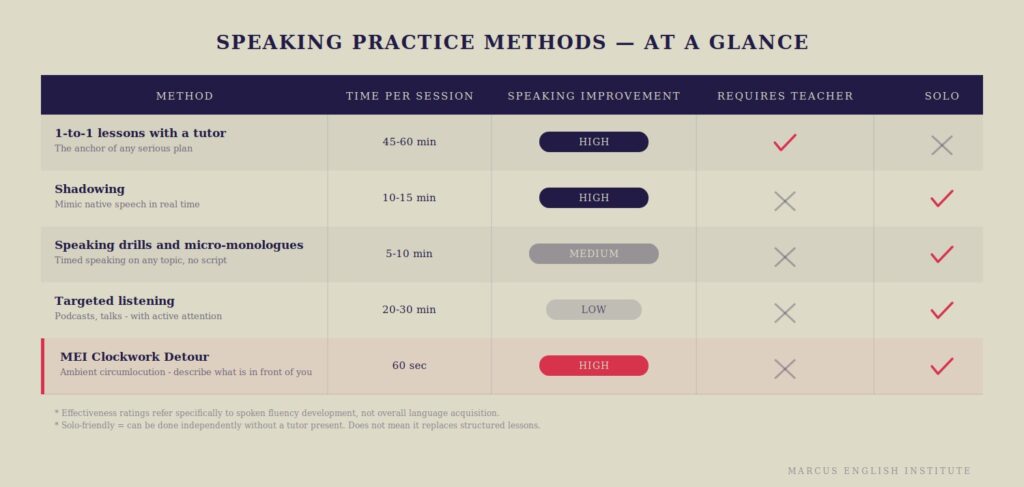
Here’s what actually works when your time is genuinely limited — ranked roughly by effectiveness for spoken fluency development.
1. Structured Speaking Practice with a Teacher (Even One Session a Week)
This is the most efficient use of your limited time. One focused 50-minute session with a qualified teacher does more for your speaking than five hours of self-directed activity. The reason is simple: you’re producing language, receiving immediate expert correction, and being pushed into the specific patterns and vocabulary you haven’t automated yet. That said, the sessions only work if what happens between them is also structured — your teacher should assign specific targeted practice for the days in between, so you’re not working in the dark.
MEI’s 1-to-1 online lessons for adults are built exactly around this model: one weekly session with a CELTA-certified tutor, combined with guided practice between lessons. The schedule is structured enough to create real progress and flexible enough to fit around professional life.
2. Shadowing (10–15 Minutes, Anywhere)
Shadowing is the most underused technique for adult learners with time constraints: you listen to a native speaker and simultaneously repeat what they’re saying, mimicking intonation, rhythm, and connected speech patterns in real time.
It feels ridiculous for the first week. Then it starts working.
Five to fifteen minutes of daily shadowing produces measurable improvement in pronunciation, rhythm, and speaking confidence within weeks. The key is choosing material at the right level — roughly 80–85% comprehensible — and using the same clip repeatedly until you can shadow it fluently before moving on. Podcasts, TEDx talks, and interview recordings all work well. Your teacher can help you choose.
3. Speaking-Focused Flashcard Drills (5–10 Minutes)
Traditional flashcards test recognition. Speaking-focused drills test production. The difference: instead of reading a word and matching it to a translation, you see a situation prompt (“your client asks you to explain a delay in the project”) and you have to produce the relevant vocabulary and structures aloud, immediately, without translating first.
This mimics real communicative pressure and trains your brain to retrieve language faster. It’s uncomfortable if you do it properly. That discomfort is the point. You can build your own prompts or ask your teacher to create a bank of scenarios relevant to your professional context.
4. Micro-Monologue Practice (2–3 Minutes, Daily)
Pick a topic — anything — and speak about it in English for two to three minutes without stopping, without translating, without going back and correcting yourself. Record it if you can.
This is not glamorous. It is effective. The goal isn’t to say smart things — it’s to keep producing language fluently under self-generated pressure. Over time, your retrieval speed improves, your tolerance for ambiguity increases, and the mental bottleneck that causes you to freeze in real conversations starts to loosen.
If you’re working with a teacher, send the recordings. The feedback you get on patterns you don’t notice yourself is worth more than the practice alone.
5. Targeted Listening (Passive Time, Active Processing)
Listening to English during your commute, gym session, or lunch break won’t transform your speaking. But it does contribute to your overall language development — especially if you’re listening at the right level and occasionally pausing to repeat phrases aloud.
The difference between background noise and comprehensible input is attention. Half-listening to an English podcast while checking emails does very little. Listening with focus, even for twenty minutes, builds vocabulary, familiarises you with natural speech patterns, and provides material for your shadowing practice.
6. The MEI Clockwork Detour (60 Seconds, Wherever You Are)
Set two or three alarms on your phone at times you know you can steal sixty seconds: mid-morning, after lunch, on your commute home. When the alarm goes off, look at the nearest object, person, or action in front of you — and describe it in English, out loud, without using its name.
The person delivering parcels to your building becomes “a professional whose job is to collect items from a central depot and distribute them to individual addresses.” Your dinner becomes “a hot meal typically eaten in the evening, often the main one of the day.” A traffic jam becomes “a situation in which vehicles are stationary or barely moving, usually because the road ahead is blocked.”
We built the Clockwork Detour around the established principle of circumlocution training — the deliberate practice of navigating around vocabulary gaps using the language you already have. The alarm-and-environment structure is our own: rather than a classroom prompt or a flashcard, you’re working with whatever is literally in front of you, which adds an element of unpredictability that keeps the exercise genuinely demanding. Combined with relative clauses, definitional structures, and semantic reformulation, what you’re training is exactly the skill that stops you freezing mid-sentence when a word won’t come — you stop stalling and reroute instead.
The alarm structure also creates spaced retrieval practice distributed across your day, which research on memory consolidation consistently finds more effective than the same total time spent in a single block.
Your tutor can refine which structures to target and give you feedback on recordings — but the basic drill you can start today, with no materials, no app, and sixty seconds you already have.
Building a Weekly Speaking Routine When You Have Limited Time
Here’s a realistic framework for someone with roughly two to three hours per week — the minimum for meaningful spoken progress.
- 1 x 50-minute 1-to-1 lesson (speaking, correction, structured progression)
- 3–4 x 10-minute shadowing sessions (commute, lunch, before bed)
- Daily micro-monologue: 2–3 minutes speaking aloud on any topic
- 2 x 15-minute targeted listening sessions with active engagement
That’s approximately two and a half to three hours across the week. Most of it fits into time you’re already spending on something else. The only session that truly requires your full undivided attention is the live lesson — and that’s also the one doing the most work.
The thing is, the independent practice only works if it’s purposeful. Random shadowing of random content at the wrong level, micro-monologues with fossilised errors you’re not aware of, listening to material that’s too easy — all of this feels like practice and accomplishes significantly less than the same time spent with a clear plan. The teacher’s job is partly to design that plan and adjust it weekly. The student’s job is to execute it.
Speaking English at Work: How to Turn Your Job Into a Practice Ground
If your work involves any English at all — emails, occasional calls, international colleagues — you’re sitting on an underused practice opportunity.
Prepare Micro-Scripts for Predictable Situations
Most professional English situations are actually quite predictable. The opening of a meeting, the way you explain a delay, the phrases you use to ask for clarification, the structure of a status update — these repeat. Preparing short, confident scripts for these moments isn’t cheating. It’s efficiency. A good teacher can help you build and rehearse these.
Speak Up More in Meetings (Even When It’s Uncomfortable)
Staying quiet in meetings because your English isn’t perfect is understandable. It’s also a strategy that guarantees your English stays exactly as imperfect. Saying something imperfect — and surviving the experience — is how you start building the tolerance for real communicative pressure. You don’t need to be brilliant. You need to be present.
Write and Read Aloud
After writing an email in English, read it aloud before sending. This sounds eccentric and is genuinely useful: it forces your brain to process the written language as spoken language, builds familiarity with professional register, and occasionally reveals sentences that are grammatically fine but would sound unnatural if spoken.

What About Language Exchange Partners?
Language exchanges — finding a native English speaker who wants to learn your language and trading conversation time — are a popular recommendation. They’re also significantly less effective than most people assume.
The problems: native speakers are generally too polite to correct you consistently. You tend to stay in your comfort zone, using the same constructions in the same slightly-wrong way without anyone pushing you forward. And the exchange format means roughly half the session is spent on the other person’s language goals. You’re getting maybe twenty minutes of English speaking time, uncorrected and unstructured.
Language exchanges are better than nothing. They’re also not a substitute for structured practice with expert feedback. Think of them as a confidence supplement, not a core method.
A Note on Accent and Pronunciation
Pronunciation is one of the areas where self-directed practice has clearest limitations. You can’t reliably hear your own accent — which means you can’t correct what you don’t notice. Shadowing helps, but it needs to be combined with feedback on whether you’re actually reproducing the sounds correctly.
For adults whose primary goal is professional intelligibility — being understood clearly in meetings, calls, and presentations — a combination of shadowing, phonetic awareness work, and ongoing pronunciation correction from a qualified teacher is the most effective route.
For adults who want significant accent reduction or want to adopt a very specific accent — BBC English, General American, and so on — a specialist accent coach or dialect coach does a different and more focused kind of work. They’re expensive, and MEI’s tutors aren’t trained specifically in that niche. Worth knowing. If that’s your goal, it’s worth considering both options and being clear about which problem you’re actually trying to solve.
When Structure Matters More Than Volume
The adult learners who improve fastest aren’t the ones who find the most time. They’re the ones who use their limited time most deliberately.
That requires a plan — and someone to design and update the plan as you progress. Independent practice without guidance is better than nothing. Independent practice with a weekly anchor session, assigned materials, and ongoing correction is a completely different proposition.
At Marcus English Institute, every learner gets a programme built around their actual goals, their professional context, and their schedule. All tutors are CELTA-certified with at least ten years of adult teaching experience. Sessions are online, one-to-one, and structured with enough flexibility to fit real working life. The results: a 99.8% satisfaction rate, 20,000+ classes delivered, and 5/5 across three independent review platforms — but more to the point, learners report actually being able to speak English in the situations that matter to them. If you’re curious whether MEI is the right fit, you can book a free Chemistry Call here — no hard sell, no commitment. Just a conversation to see if we’re a good match.
FAQ — Frequently Asked Questions
How often should I practise speaking English to see results?
Consistency matters more than volume. Two to three hours of structured activity per week — including at least one live session with a qualified teacher — is a realistic minimum for meaningful spoken progress. Shorter, more frequent sessions tend to outperform occasional long ones.
Can I improve my English speaking without a teacher?
You can improve, but with real limitations. Without corrective feedback, fossilised errors — mistakes that feel natural because you’ve been making them for years — tend to calcify rather than resolve. Independent methods like shadowing and micro-monologue practice are valuable complements to structured lessons, not replacements for them.
What is the best way to practise speaking English at home?
Shadowing is the highest-value independent speaking exercise: listen to a native speaker and simultaneously repeat what they say, mimicking intonation and rhythm. Combine this with daily micro-monologues (two to three minutes of speaking aloud on any topic) and targeted listening at the right level. Record yourself when you can.
Is speaking English every day necessary?
Daily practice is ideal but not always realistic for adults with full professional and personal lives. What matters more is that your practice, whenever it happens, is structured and purposeful. Ten focused minutes of shadowing or speaking drills is worth more than an hour of passive listening.
How can I practise conversational English if I have no one to speak to?
Micro-monologues, shadowing, and speaking-focused flashcard drills are all effective for solo practice. For anything approaching real conversational practice — turn-taking, responding to unexpected questions, managing misunderstanding — you need a real interlocutor. A qualified teacher is the most efficient option; language exchanges can supplement, though they have real limitations.
Do language learning apps help with speaking English?
Apps can be useful for vocabulary retention and basic comprehension. They cannot give you real-time corrective feedback on spoken production or adapt to your specific communicative needs. Think of them as supplementary tools with a real ceiling — not the core of a speaking practice plan.
One session a week. A plan that actually works. ☺️
Everything in this article works significantly better when someone qualified is choosing the material, catching the errors you can’t hear yourself, and updating the plan as you improve. That’s not a sales pitch — it’s just how structured learning works.