
Speak English Well as an Adult: 7 Proven Methods

There’s a gap that nobody talks about enough. It sits right between ‘I can get by in English’ and ‘I actually speak English well’ — and for millions of European adults, it’s where they’ve been stuck for years.
You can hold a basic conversation. You can manage a hotel check-in, read a contract, understand an email. You survived a meeting in English last month — technically. But something’s off: you hesitate too much, your sentences come out clunky, your vocabulary feels thin when it matters most, and there’s always that nagging sense that you sound like a slightly better-organised version of a phrase book.
That’s not a beginner’s problem. It’s a fluency problem. And it needs a different kind of solution.
This article is specifically for adults who already speak some English but want to speak it well — with clarity, confidence, and the kind of natural flow that doesn’t make you want to edit yourself in real time. If you’re starting completely from scratch, you’ll want to read our full guide on how to learn to speak English as an adult first.
If you already know you need more than tips — and want structured, personalised coaching — MEI’s 1-to-1 online English lessons for adults are designed exactly for this stage.
The Difference Between Speaking English and Speaking English Well
This distinction matters more than most learning resources acknowledge.
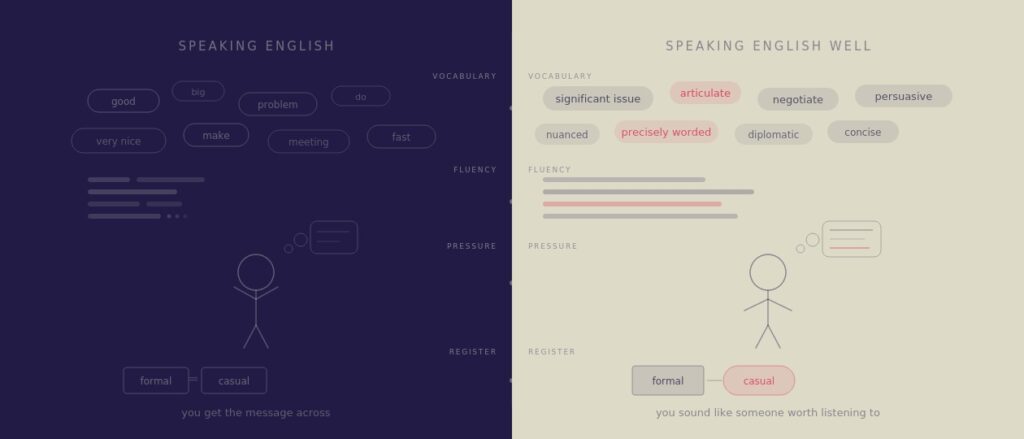
Speaking English means you can communicate — ideas get across, people understand you, nobody has to repeat themselves three times. Fine. Useful. But ‘speaking English well’ is a different standard entirely. It means:
- Your vocabulary is precise, not just approximate
- Your sentences land the way you intend them to
- You can adjust register — formal for a board presentation, casual for a client dinner
- You don’t freeze under pressure or default to safe, oversimplified phrasing
- You sound like someone worth listening to — not someone fighting the language
The gap between these two levels is where professional credibility lives. In an interview, a negotiation, a presentation, or even an important client email, ‘getting by’ is simply not enough. The quality of your English affects how you’re perceived — and that has real consequences.
Why Intermediate Speakers Get Stuck (The Plateau Problem)
If you’ve been at roughly the same level for the past year or two despite occasional study or exposure — you’re experiencing what language specialists call the intermediate plateau. It’s real, it’s common, and it’s not your fault.
Here’s what’s actually happening: at the intermediate level, you’ve acquired enough English to function. Which means the urgency that drove early progress disappears. You no longer need to learn — you can cope. And ‘coping’ quietly becomes the new normal.
What keeps people stuck:
You’re not being corrected anymore
Colleagues, friends, and even casual language exchange partners let your errors slide. They understand you, so why bother pointing out that you consistently misuse the present perfect, or that your intonation pattern is throwing people off? Without corrective feedback, errors fossilise. They become part of your English — and they’re very hard to undo without deliberate intervention.
Your input is above your output
You can probably understand a lot more English than you can produce spontaneously. Reading and listening are receptive skills — they don’t automatically transfer into speaking. At the intermediate level, many adults consume English passively (Netflix, podcasts, articles) while barely practising the active production side. The gap widens.
You’re still translating in your head
Most intermediate speakers compose sentences in their native language first, then translate. This creates a ceiling on fluency because translation is slow, imprecise, and burns cognitive resources you need for other things — like listening to the person you’re talking to. Breaking this habit requires specific, targeted practice — not just more hours of general study.
Your vocabulary is wide but shallow
You know a lot of words. You don’t know how to use most of them naturally — the collocations, the register, the subtle distinctions between synonyms. The result is English that sounds slightly off to a native speaker without them being able to say exactly why. ‘This is a big problem’ and ‘this is a significant issue’ are not interchangeable in a formal context. Knowing both words doesn’t mean you know the difference.
7 Methods That Actually Help You Speak English Well (Not Just Adequately)
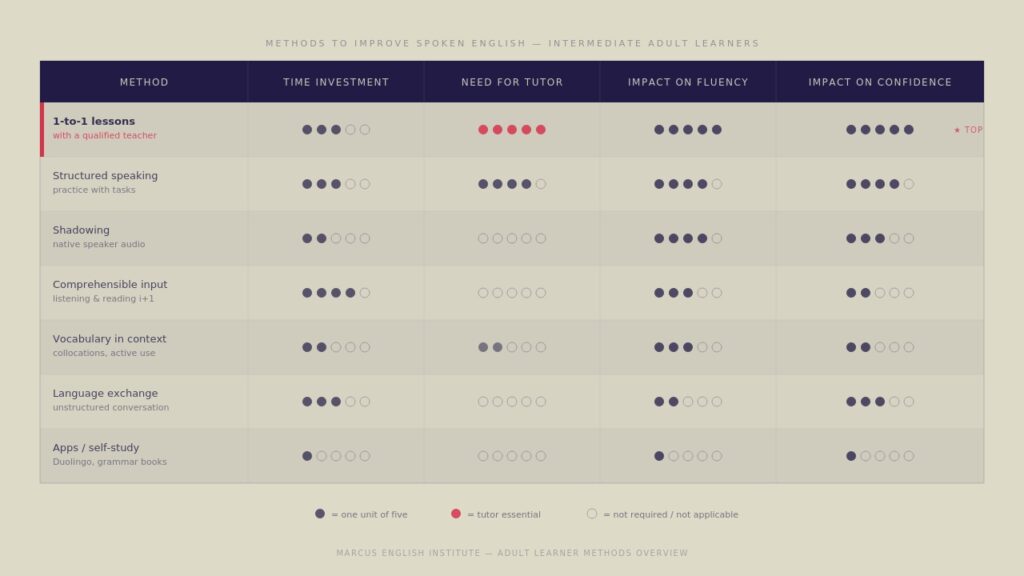
1. Work with a teacher who corrects you specifically
This sounds obvious. It’s worth saying anyway, because most adults ‘practise English’ in environments where no correction happens. A qualified teacher — not a native speaker friend, not a conversation partner, not an app — will notice that you’re confusing ‘since’ and ‘for’, that you’re overusing the past simple when the present perfect would be more natural, that your spoken word stress is making you harder to understand. And they’ll fix it. Consistently, systematically, over time.
The key is ‘qualified’ and ‘experienced with adults.’ A CELTA-certified teacher with adult teaching experience understands how intermediate speakers plateau and how to move them forward. A native speaker with enthusiasm does not. They’re not the same thing.
2. Practise output, not just input
Speaking well is a production skill. You cannot develop it primarily through reading, listening, or watching. You develop it by speaking — regularly, with feedback, under conditions that push you slightly beyond what’s comfortable.
Structured output practice means: being given a specific task (explain this concept, argue this position, describe this process), performing it, and receiving expert feedback on exactly where it breaks down. This is different from unstructured conversation practice, which tends to plateau quickly because you gravitate toward what you already know how to say.
3. Target your vocabulary gaps — precisely
Don’t try to learn more words. Try to learn to use the words you know better. At intermediate level, vocabulary gaps are usually about depth, not breadth: you know the word but not its collocations, register, or surrounding patterns.
One practical approach: after every speaking session, note phrases where you felt you reached for a word and settled for the wrong one. Bring those to your tutor. Work on alternatives in context. Then use them actively within 24 hours, not just review them passively.
4. Develop register awareness
One of the clearest markers of truly good English is the ability to adjust register appropriately — shifting from the directness needed in a quick Slack message to the measured, diplomatic language of a difficult negotiation. This is a skill that takes deliberate cultivation.
Start noticing the language around you: how do native English speakers phrase requests differently depending on context? How does formality shift between a job interview and a team lunch? Listen critically, not just for comprehension but for the choices speakers make. Then practice replicating those choices intentionally.
5. Shadow native speakers — but deliberately
Shadowing is criminally underused. The technique: listen to a native speaker and simultaneously reproduce exactly what they say, mimicking rhythm, intonation, and pronunciation in real time. The goal isn’t to understand — you’ll have already listened to the audio once. The goal is to internalise the patterns: where stress falls, how sentences link, where native speakers naturally pause.
Five to ten minutes of disciplined shadowing daily — with audio you’ve chosen because it matches the kind of English you need to produce — will produce noticeable change in how natural your spoken English sounds within weeks.
6. Speak in your discomfort zone
Good language teachers know this: improvement happens at the edge of your current ability, not safely within it. If every speaking session stays comfortably within what you already know you can do, you’re not building new capacity — you’re maintaining existing capacity, which is pleasant and entirely useless.
This means practising situations you find difficult: the unexpected question in a meeting, the conference call where you need to hold a position under challenge, the presentation to an unfamiliar audience. In a well-designed 1-to-1 lesson, a teacher creates those pressure situations deliberately, so you build the skill before you need it for real.
7. Get your pronunciation assessed — not just corrected
There’s a difference between fixing individual pronunciation errors as they arise (which most teachers do) and getting a full pronunciation assessment (which most don’t). An assessment tells you: which sounds you’re producing incorrectly, which stress patterns are affecting comprehension, and whether your intonation is carrying the right meaning.
For European adults, the specific challenges vary by native language. Italian speakers tend to add vowels after consonant clusters; French speakers often underplay word stress; German speakers can be overly staccato. A teacher who knows your L1 can diagnose these patterns and address them systematically — rather than correcting errors randomly as they surface.
The Role of Confidence — and Why It’s Not What You Think
‘I just need more confidence’ is one of the most common things adults say about their English. Usually, what they mean is: ‘I need to feel less anxious when I speak English.’
Here’s the uncomfortable truth: confidence in speaking is almost always a consequence of competence, not a prerequisite for it. You can’t think your way to confidence — you have to build the underlying skill until it becomes automatic enough that it doesn’t demand your full conscious attention. At that point, something that felt effortful starts to feel easy.
The practical implication: don’t wait until you feel confident to practise in high-stakes situations. The high-stakes situations — with enough of them, in a structured setting — are exactly what will produce the confidence. Work with a teacher who puts you in those situations regularly, within a safe and corrective environment.
There’s a decent amount of research supporting this view. The British Council’s findings on adult language learning consistently show that adults who practise in realistic, communicative settings with expert feedback outperform those who study in lower-pressure, non-corrective contexts — even when total study hours are similar.
What ‘Speaking English Well’ Looks Like in Professional Contexts
This is the specific area where most European adult learners feel the gap most acutely — and where speaking English well (as opposed to just speaking English) matters most.
Professional fluency has layers that general fluency doesn’t. You need to:
- Hold your ground in a discussion conducted in your second language, without losing either accuracy or authority
- Read the room — which means detecting tone, managing unspoken dynamics, knowing when to push and when to wait
- Handle ambiguity gracefully — in English, much professional communication is deliberately indirect. ‘That’s an interesting approach’ is not a compliment.
- Speak with appropriate precision — ‘it’s a bit complicated’ and ‘this presents some structural complexity’ are not the same sentence in a boardroom
- Recover from mistakes without visibly rattling — which, again, comes back to practised automaticity
Generic English courses rarely target any of this specifically. Which is why professionals who’ve done years of general English study still feel underprepared in high-stakes professional situations: they were never given the right kind of practice.

How Long Does It Take to Go from ‘Adequate’ to ‘Good’?
Honest answer: less than most people assume, but more than a weekend course will deliver.
The CEFR (Common European Framework of Reference) puts the jump from B1 to B2 at roughly 150-250 hours of structured learning — but that figure assumes broadly general language development. If your goal is specifically spoken fluency, with targeted output practice and corrective feedback built into every session, that number can reduce significantly.
What makes the difference isn’t hours — it’s the quality and targeting of the practice. An adult doing two to three hours of high-quality, structured speaking practice per week (one live session with a tutor, plus tutor-assigned exercises between sessions) will progress faster than someone spending five hours per week on apps and passive listening.
Realistically: adults starting from a solid intermediate base and working consistently with a qualified teacher typically report meaningful, noticeable improvement in speaking quality within three to six months. That’s not fluency from scratch — that’s the gap between ‘I manage’ and ‘I’m actually good at this.’
FAQ — Frequently Asked Questions
How do I start speaking English more fluently as an adult?
Fluency improves through output practice with feedback — not through more input. The most effective starting point is regular speaking sessions with a qualified teacher who will give you structured tasks, correct your errors in real time, and push you into situations that are slightly harder than what you can already handle comfortably. Passive study (listening, reading, apps) supports fluency but cannot create it on its own.
What is the fastest way to improve my spoken English?
Living in an English speaking country in a highly interactive professional and personal environment. Second best is consistent 1-to-1 lessons with a qualified teacher, combined with deliberate speaking practice between sessions. The combination of personalised feedback, structured output, and targeted error correction accelerates progress more than any other approach — particularly for adults who are past the beginner stage and need to break through a plateau.
Why do I speak English well in some situations but freeze in others?
Spoken fluency isn’t uniform — it degrades under pressure. In low-stakes situations (casual conversation, familiar contexts), your existing English handles the load. In high-stakes situations (presentations, negotiations, unexpected questions), the extra cognitive demand exposes the gaps. The solution isn’t more general practice — it’s deliberate practice in exactly those high-pressure scenarios, ideally with a teacher who recreates them safely and systematically.
Does watching English films and series help me speak better?
It helps with comprehension and passive familiarity with natural speech patterns. It does not, on its own, improve your speaking. Passive input and active output are different skills. Use films and series as exposure — not as a study plan substitute. The speaking skill is built by speaking.
Is online English learning effective for improving spoken fluency?
Yes — particularly for 1-to-1 video-based lessons, which replicate the real-time communication dynamics of spoken interaction (listening, producing, turn-taking, facial reading) that matter most. Online learning also removes the commute and gives you access to a much broader pool of qualified teachers than geography alone would allow.
How do I sound more natural when speaking English?
Work on rhythm, intonation, and collocations — not just grammar. Natural-sounding English is less about grammatical perfection and more about using words the way native speakers use them, with the stress patterns and sentence rhythms they’d expect. Shadowing practice helps significantly with this. So does working with a teacher who focuses specifically on what makes your English sound non-native, and addresses it systematically.
Ready to go from ‘I manage’ to ‘I’m actually good at this’? ☺️
If you’ve been stuck at ‘adequate’ long enough, MEI’s 1-to-1 online English lessons are worth a serious look. Every session is built around your specific gaps, your professional context, and your actual goals — not a generic curriculum designed for an imaginary average learner. With 99.8% satisfaction, 20,000+ classes delivered, and 5/5 across three independent review platforms, the results speak for themselves.