
English Learning Apps vs Online Lessons: An Honest Answer
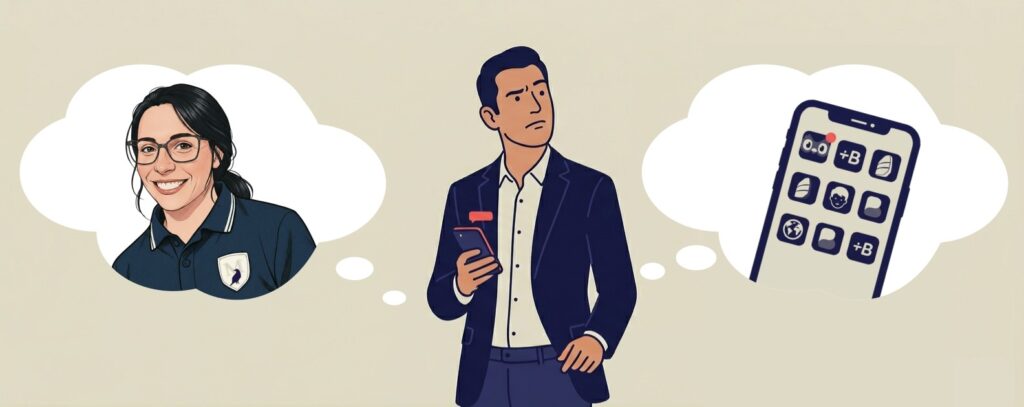
You’ve downloaded the app. Done your daily streak for three weeks running. The little cartoon owl is very proud of you. And yet, the next time a colleague opens a Teams call with ‘Morning, shall we do this in English?’ your stomach still drops. That’s where English learning apps vs online lessons show their differences.
Here’s what nobody tells you: the problem isn’t your dedication. It’s that apps and lessons are solving completely different problems. Confuse one for the other, and you’ll spend years doing something that feels productive but doesn’t actually move the needle on the thing you need.
What follows is an honest breakdown of what English learning apps genuinely do well, where they fall short, and when online lessons with a qualified teacher are the better investment. No brand wars, no affiliate links: just a clear-eyed comparison so you can make a smarter decision about your time and money.
If you’re already past the ‘apps vs lessons’ question and want to understand how structured 1-to-1 online English lessons work in practice, you can start with MEI’s individual lesson programme for adults.
What English Learning Apps Actually Do Well
Let’s start where honesty requires us to start: apps aren’t useless. They’re just frequently misunderstood.
Vocabulary Building (Especially at Beginner Level)
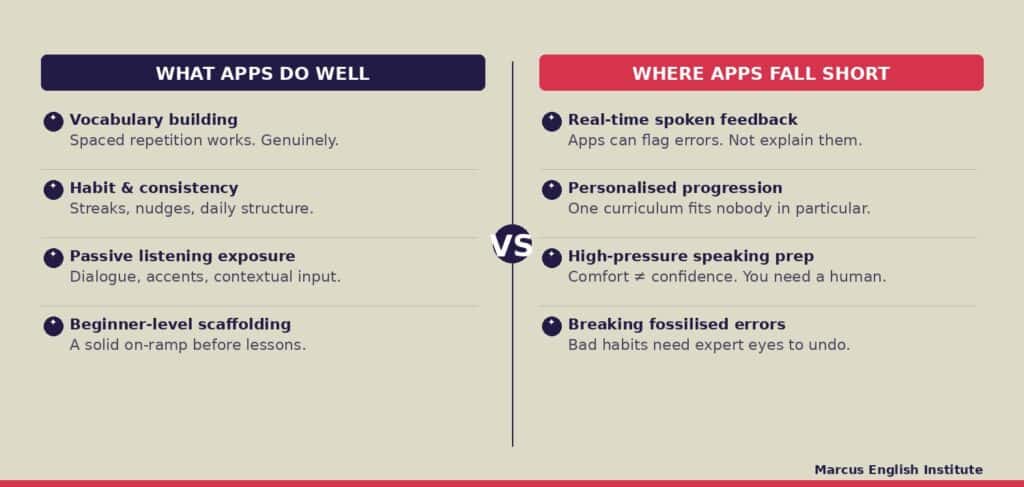
Spaced repetition is genuinely effective for vocabulary retention. It’s the method behind apps like Anki and built into most major language apps; if you’re building from scratch, or if you need to acquire a specific set of professional terms fast, a well-designed app can help you do that efficiently.
The operative word is ‘efficiently’, not ‘completely’. Knowing a word and being able to use it spontaneously in speech are two very different cognitive skills. Apps build the first. They struggle with the second.
Daily Consistency and Habit Formation
Streak mechanics, push notifications, gamified rewards: these things work. Not because adults are children who need stickers, but because motivation is fragile and habit scaffolding genuinely helps. If you have a weak language learning routine, an app can provide structure.
Again: structure for the habit, not structure for the learning itself. Those are different things.
Passive Exposure and Listening
Some apps do a decent job of exposing you to natural spoken English: authentic dialogue, varied accents, contextualised listening exercises. For receptive skills (understanding what you hear), this kind of input has real value, particularly when applied at the right level; material you understand most of, but not all of.
Where English Learning Apps Fall Short
Here’s where the honest part gets uncomfortable for app developers: there are things language apps structurally cannot do, regardless of how sophisticated they become.
They Can’t Give You Real-Time Spoken Feedback
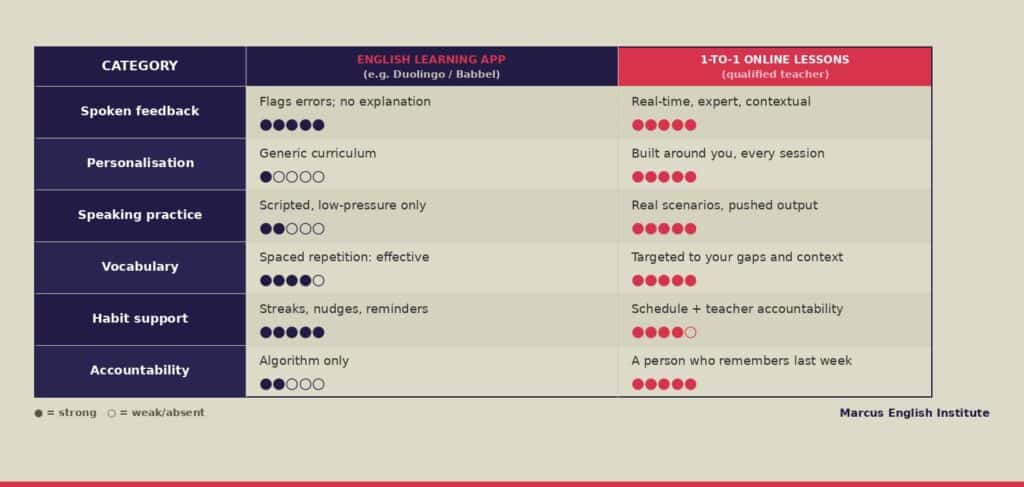
Speaking is a skill. Like driving, it requires someone watching you do it and telling you where you’re going wrong. Apps can run speech recognition; they can flag that your pronunciation was off. What they cannot do is explain why, give you a specific correction, model the correct version, and have you practise it again in a meaningful context.
Corrective feedback from an expert teacher is, by some distance, the most effective tool for accelerating spoken fluency in adult learners. No app provides it.
They Can’t Adapt to Your Actual Situation
The app doesn’t know you’re a French cardiologist who needs to present research at international conferences. It doesn’t know you’re a German architect who negotiates contracts in English with British clients. It doesn’t know which specific errors you make repeatedly, which sounds you consistently get wrong, or which grammatical structures haven’t stuck after four years of trying.
A qualified teacher knows all of this by session three. And every subsequent session is built around what you actually need: not a curriculum designed for a hypothetical average learner.
They Won’t Push You Through the Barriers That Actually Matter
Feeling understood by an app is not the same as communicating under pressure. The anxiety of speaking English in a real situation, with a real person, in real time, where something is actually at stake: that’s not something you can simulate with a language app. The only cure for it is repeated exposure to lower-stakes situations with feedback. That means a human.
Apps are very comfortable — and that’s the problem.
They Create a Productivity Illusion
A completed lesson on a language app feels like learning. The owl celebrates. The XP accumulates. But if you’ve been doing 15 minutes of app exercises every day for a year and still can’t hold a conversation without freezing, you haven’t been learning to speak English; you’ve been learning to do app exercises.
The two things correlate weakly, at best.
What Online Lessons with a Qualified Teacher Do That Apps Can’t
To be clear: ‘online lessons’ is not a monolithic category. A freelance native speaker from a tutoring platform and a trained teacher with a decade of adult education experience are not the same thing. The difference matters enormously. When we say ‘qualified teacher’, we mean the second.
Real-Time Corrective Feedback on Spoken Output
You speak. They correct. You practise the correction. You speak again. This feedback loop, repeated consistently over weeks and months, is what builds actual fluency. It’s what closes the gap between ‘I understand English’ and ‘I can use English when it matters’.
Personalised Progression
A good teacher diagnoses where you are and builds a plan around where you need to go. Between live sessions, they assign targeted exercises: specific to your gaps, your goals, your professional context. It’s guided practice, not guesswork. The structure is there; the flexibility is there too.
Speaking Practice That Mirrors Real Situations
Job interviews, difficult phone calls, presentations to international teams, negotiations: these aren’t hypothetical scenarios in a coursebook. They’re the actual situations that prompted you to look for better English in the first place. A qualified teacher can simulate them, push you through them, and correct you in the moment. An app cannot.
Accountability That Actually Holds
Regular sessions with a teacher you’ve committed to work with create a different kind of accountability than a streak counter. Adults who report fastest improvement consistently point to the same thing: a fixed routine with a person who knows their work, remembers their last session, and has expectations for this one.
When an App Is Actually the Right Tool
To be fair (and we said we’d be honest): there are scenarios where apps are genuinely the better choice, or a sensible part of the picture.
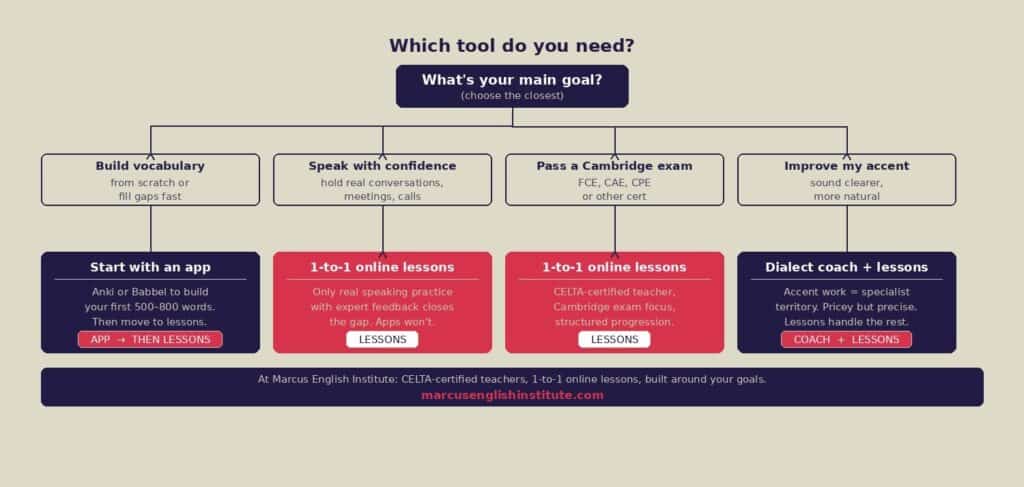
- You’re a complete beginner and need to absorb basic vocabulary before starting lessons. A few weeks of app use to get the first 500-800 words in place is not a bad idea.
- You’re supplementing a lesson programme and want something to maintain vocabulary between sessions. Using spaced repetition to reinforce words introduced by your teacher is a legitimate use case.
- Your goal is reading or listening comprehension, not spoken fluency. If you need to read academic papers in English but have no immediate need to speak it, apps can contribute meaningfully.
- You have genuinely no budget for lessons right now. An app is better than nothing; it just won’t do the job most adults need it to do.
What an app should never be: your primary strategy for becoming a confident English speaker. It wasn’t designed for that. The architects of Duolingo know this; they say so in their own research papers. The product roadmap and the marketing — perhaps — say something rather different.
A Note on Dialect Coaches and Accent Training
Worth naming separately if accent reduction or accent acquisition is your specific goal: this is a distinct specialisation. A CELTA-certified English teacher works on pronunciation within the broader context of communication, fluency and accuracy. A dialect coach works specifically on accent modification, voice placement and phonemic restructuring; it’s a different thing entirely.
Dialect coaches tend to be excellent at exactly that. They’re also significantly more expensive, and less suited to the broader language development most adult learners actually need. If you’re specifically preparing for a role that requires a particular accent (acting, broadcasting, specific professional contexts), a dialect coach is the right specialist. If you want to be understood clearly and speak with more confidence: a qualified teacher handles that.
The Honest Verdict: App for Learning English vs Online Lessons
Apps are good at building vocabulary habits and providing passive exposure. They’re free or cheap. They’re available at 11pm when you can’t sleep. These are real advantages.
But if your goal is to actually speak English, confidently, accurately, in situations that matter: they’re the wrong primary tool. Not because the technology is bad, but because speaking is a social, real-time skill that requires a social, real-time practice environment. Apps don’t provide that.
The clearest way to put it: apps can build the vocabulary. Only consistent speaking practice with expert feedback can build the speaker.
Most adults who’ve been stuck for years are doing plenty of the first and almost none of the second. That’s the thing to fix.
FAQ: English Learning Apps vs Online Lessons
Are English learning apps worth it?
For vocabulary building and maintaining daily consistency, yes. For developing spoken fluency and closing the gap between passive comprehension and active communication: no app currently on the market does what a qualified teacher with real-time feedback does. They’re most valuable as a supplement to a structured learning programme, not as the programme itself.
Can I learn English to a professional level using only apps?
Almost certainly not, if speaking is part of the goal. Apps can take you a long way with reading and listening at lower levels, but professional fluency, especially in spoken high-stakes contexts like meetings, presentations or negotiations, requires personalised feedback and structured output practice that only a teacher can provide.
What’s the best English learning app for adults?
Depends what you mean by ‘best’. For spaced repetition vocabulary, Anki remains extremely effective (and free). For structured beginner input, Babbel is more adult-oriented than most. For pronunciation, ELSA Speak has a specific focus and is worth a look. None of them replace spoken practice with a qualified teacher.
How do online English lessons work?
In a well-structured programme, you meet your teacher regularly for a live one-to-one video session. Between sessions, your teacher assigns specific practice: exercises, vocabulary, drills, listening tasks, all calibrated to your level and goals. It’s part live teaching, part guided self-study, with your teacher tracking progress and adjusting the plan as you improve.
Is it better to learn English with an app or a teacher?
For vocabulary and passive skills: an app is a reasonable tool. For speaking, confidence and real-world fluency: a qualified teacher is the answer. Ideally, both have a role; the app supplements the teacher’s work between sessions. The mistake most adults make is treating the app as the main event.
How much do online English lessons cost compared to an app?
Apps typically cost between free and around 15 euros a month. Online lessons with a qualified teacher range widely; from budget tutors on freelancing platforms to more structured programmes that cost more but include a proper learning architecture. The relevant comparison isn’t cost per session: it’s cost per meaningful improvement.
Ready to stop doing app exercises and start actually speaking? ☺️
If you’re a European adult who understands English well enough but needs to use it confidently in real situations, we might be exactly what you’re looking for. At MEI, every learner gets a programme built around their actual goals, with CELTA-certified teachers who have at least ten years of adult teaching experience. No group classes, no apps, no generic coursebooks.